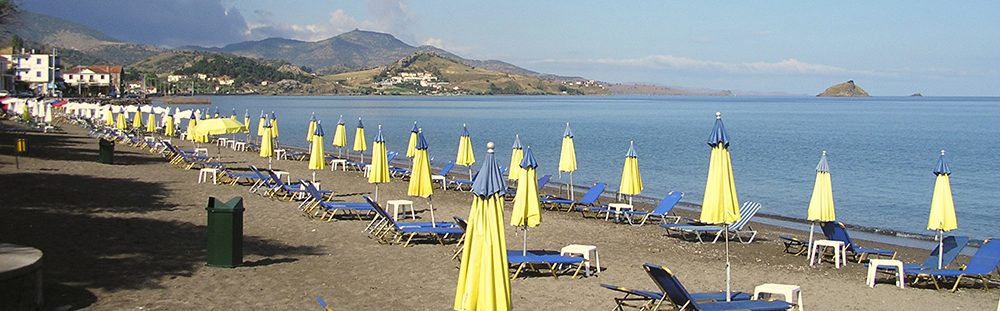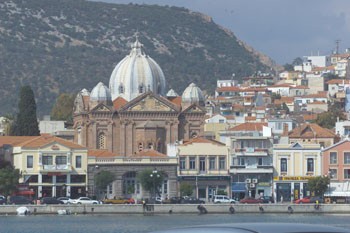
According to myth, the first inhabitants of Lesvos were the Pelasgeans, who gave it its initial name ?Pelasgia? . During the Prehistoric era, the island was called "Makaria", "Lassia", "Aeolis", "Ethiope". but its current name "Lesvos" comes from Lesvos Island "Lesvos", son of the Greek hero Lapithos. Most town names like "Mytilene", "Kalloni", "Antissa", "Eressos", "Mithymna" have a mythological origin.
The birthplace of many notables in the arts and letters, such as Thrasyvoulos Stavrou, Neoklis Kazazis, Takis Eleftheriadis, Orestis Kanellis,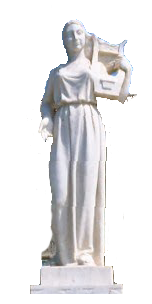 et al, it’s well known today for its active Cultural Center and its library housed in the neoclassical stone building of the former Girls’ Academy.
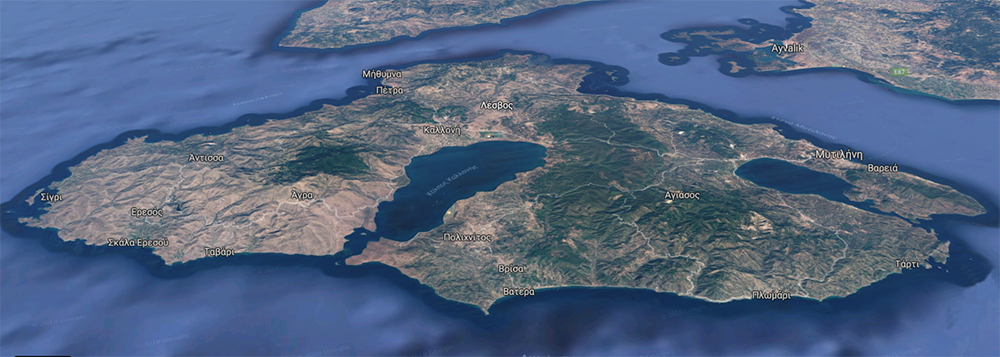
Lesvos or Lesbos, (pronounced as Lezvos) is an island located in the northeastern Aegean Sea. It has an area of 1,643 km2(631 sq mi) with 320 kilometres (199 miles) of coastline, making it the third largest island in Greece. It is separated from Turkey by the narrow Mytilini Straitand in late Palaeolithic/Mesolithic times was joined to the Anatolian mainland before the end of the last glacial period.
The capital of the Lesvos Island is Mytilene. The population of Lesbos is approximately 97,000, a third of whom live in its capital, Mytilene, in the southeastern part of the island. The remaining population is distributed in small towns and villages. The largest are Plomari, Kalloni, the Gera Villages, Agiassos, Eressos, and Molyvos (the ancient Mythimna).
According to later Greek writers, Mytilene was founded in the 11th century BC by the family Penthilidae, who arrived from Thessaly, and ruled the city-state until a popular revolt (590- 580 BC) led by Pittacus of Mytilene ended their rule. In fact the archaeological and linguistic record may indicate a late Iron Age arrival of Greek settlers although references in Late Bronze Age Hittite archives indicate a likely Greek presence then. The name Mytilene itself seems to be of Hittiteorigin. According to Homer's Iliad, Lesbos was part of the kingdom of Priam, which was based in Anatolia (Minor Asia). Much work remains to be done to determine just what happened and when. In the Middle Ages, it was under Byzantine and then Genoese rule. Lesbos was conquered by the Ottoman Empirein 1462. The Ottomans then ruled the island until the First Balkan War in 1912, when it became part of the Kingdom of Greece.
Lesbos lies in the far east of the Aegean sea, facing the Turkish coast (Gulf of Edremit) from the north and east; at the narrowest point, the strait is about 5.5 km (3.4 mi) wide. The shape of the island is roughly triangular, but it is deeply intruded by the gulfs of Kalloni, with an entry on the southern coast, and of Gera, in the southeast.
The island is forested and mountainous with two large peaks, Mt. Lepetymnos at 968 m (3,176 ft) and Mt. Olympus at 967 m (3,173 ft), dominating its northern and central sections. The island's volcanic origin is manifested in several hot springs and the two gulfs.
Lesbos is verdant, aptly named Emerald Island, with a greater variety of flora than expected for the island's size. Eleven million olive trees cover 40% of the island together with other fruit trees. Forests of mediterranean pines, chestnut trees and some oaks occupy 20%, and the remainder is scrub, grassland or urban.
Climate
The island has a hot-summer Mediterranean climate (Csa in the Koppen climate classification). The mean annual temperature is 18C (64F), and the mean annual rainfall is 750mm (30in). Its exceptional sunshine makes it one of the sunniest islands in the Aegean Sea. Snow and very low temperatures are rare.